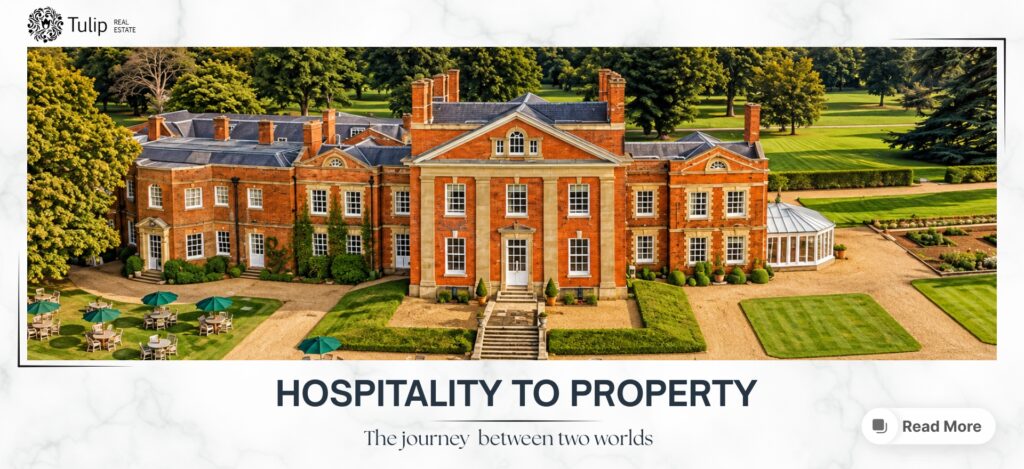
A career in hospitality teaches you to pay attention to things that spreadsheets rarely capture: how people move through a space, what makes a stay memorable, where service breaks down and which details quietly influence a customer’s decision to return. For Siddharth Mahajan, those lessons became an unlikely foundation for a second career.
After beginning his professional life in hospitality in 2001, including experience at Oberoi Rajvilas in Jaipur, Mahajan eventually moved into the UK property market and founded Tulip Real Estate. More than two decades later, the business operates across residential real estate, hotels, serviced accommodation and other property interests.
The transition is interesting because it was not a clean break between two industries. Hospitality became part of the lens through which Mahajan approached property.
The First Lessons Came From Hotels
Mahajan’s entry into the industry followed a Bachelor’s degree in Hotel Management and an International Diploma in Hospitality. His early professional experience was firmly rooted in hotel operations. That environment demands an unusual combination of commercial awareness and attention to detail. A hotel room may be a physical asset, but its success depends on what happens around it: the guest experience, service standards, location, presentation and consistency.
Those considerations become relevant when looking at Mahajan’s later work in property. The building matters. So does what the building can become.
The Move Into London
Tulip Real Estate was established in 2011, initially focusing on serviced rooms and short-lets in London’s prime business districts. The company began with nine apartments comprising 30 serviced rooms. Its early years coincided with a period of strong demand around the London 2012 Olympics, after which the business continued expanding into different forms of property. The progression was gradual rather than immediate. Additional apartments were acquired. The business moved into HMO properties, hotels and new-build developments. Over time, its interests expanded further into residential acquisitions, refurbishments, apart-hotels and property management.
That progression provides useful context for understanding Sidd Mahajan UK today. The company was not created as a fully formed property group; its current shape developed through successive additions to the business.
Where Hospitality Meets Real Estate
The overlap between Mahajan’s two professional worlds becomes clearest in Tulip’s hotel portfolio. The group has acquired properties ranging from the historic Whately Hall Hotel in Banbury to Hilton London Syon Park and DoubleTree by Hilton Swindon. They are very different properties, but each requires an understanding of the asset as an operating destination rather than simply a piece of real estate. That distinction can matter enormously in hospitality.
A hotel’s performance depends on rooms, facilities, location, brand positioning, customer demand and the quality of the experience delivered on the ground. The underlying property is only one part of the equation.
For someone whose career began inside hotels, that operating perspective is a natural part of the picture.
The Property Side Became Bigger
As Tulip developed, its activities increasingly extended beyond hospitality. Recent acquisitions include residential apartments at Landmark Pinnacle in Canary Wharf and KOA House at Battersea Power Station, alongside properties in New Kent Road and Elephant & Castle.
These transactions represent a different side of Siddharth Mahajan London, one concerned with residential assets, development locations and the changing character of London’s neighbourhoods.
The shift demonstrates how experience in one part of the property ecosystem can eventually lead into another. Understanding how people use buildings is relevant whether the building is a hotel room, an apartment or part of a larger mixed-use district.
Building a Business, Not Changing Careers
It would be easy to describe Siddharth Mahajan‘s career as a move from hospitality into real estate. The history of Tulip suggests something more gradual. The early serviced-accommodation model created a base. Hotels became part of the portfolio. Residential assets expanded the company’s reach. New developments and regeneration-led opportunities introduced another dimension. Each stage added something different to the business. That makes the story of Siddharth Mahajan less about leaving one industry behind and more about carrying useful experience from one sector into another.
What the Transition Says About Entrepreneurship
Career changes are often presented as moments of reinvention. In practice, there are frequent accumulations. Skills acquired in one environment become useful somewhere else. An understanding of customers becomes useful in asset selection. Operational experience informs investment decisions. Knowledge of one market creates confidence to explore another.
Mahajan’s career offers an example of that kind of progression.
From a hotel-management graduate beginning his career in 2001 to the Founder and Managing Director of a UK property and hospitality business, the connecting thread is not a single type of asset.
It is the ability to understand what makes a physical space work, and then build a business around that understanding.
Explore Siddharth Mahajan’s journey and the evolution of Tulip Real Estate across the UK.