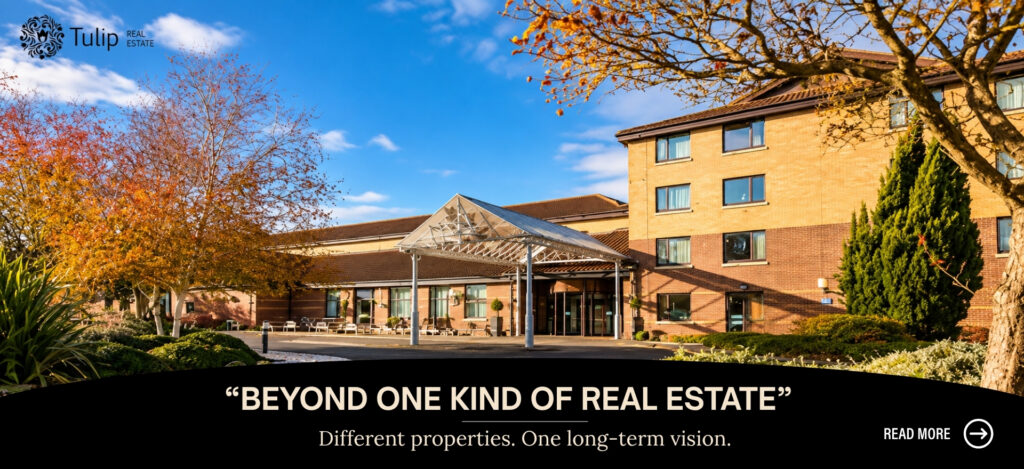
There is a difference between owning property and building a property business. The first can be measured through individual assets. The second is visible in the structures built around those assets: the companies, sectors, partnerships and areas of expertise that allow a business to keep moving into different parts of the market. That distinction is useful when looking at the career of Siddharth Mahajan, Founder and Managing Director of Tulip Real Estate. Over the years, his involvement has extended across companies connected with hotels, real estate, design and build, serviced accommodation and other property interests. Companies House records currently list Siddharth Mahajan as a director of Tulip Hotels & Real Estate, Tulip Real Estate London, Tulip Design & Build and several other active companies.
The pattern tells a more interesting story than a list of acquisitions alone. Building the
Infrastructure Around the Asset
Tulip Hotels & Real Estate dates back to 2011, when Mahajan became a director of the company. Tulip Real Estate London followed in 2018, while Tulip Design & Build was established within the wider group structure earlier, with Mahajan appointed as a director in 2016.
The significance is not simply that several companies carry the Tulip name. It reflects a gradual expansion in the kinds of businesses surrounding the core property activity. Instead of remaining tied to one narrow segment, the group developed interests spanning real estate and hospitality, while building additional corporate entities around its activities.
For an entrepreneur operating in the UK property market, that creates room to think about an asset from several perspectives rather than viewing every transaction in isolation.
From Hospitality Into a Wider Property Career
Mahajan’s route into real estate also began somewhere slightly different. His professional career started in hospitality in 2001, following a degree in Hotel Management and an international diploma in hospitality. Early experience included Oberoi Rajvilas in Jaipur before his career developed further in the UK. That background is relevant because hospitality and real estate require different ways of looking at the same physical space.
A hotel is an operating business as much as it is a building. A residential asset depends on location, demand and the quality of the underlying property. A development introduces another layer of decisions around design, delivery and timing. Over time, Sidd Mahajan UK has worked across this broader landscape rather than remaining within a single property category.
A Business That Has Expanded in Different Directions
The company’s portfolio today reflects that range. Tulip’s interests have included residential developments and apartments, serviced accommodation, hotels and heritage properties. More recent acquisitions have included 24 apartments at Landmark Pinnacle in Canary Wharf, KOA House at Battersea Power Station, Hilton London Syon Park and DoubleTree by Hilton Swindon.
These are very different assets with different audiences and commercial characteristics.
That diversity is important when considering Sidd Mahajan London as an entrepreneur. His work is less about finding one repeatable property formula and more about creating a business capable of operating across several parts of the market. The same principle can be seen in the corporate structure around Tulip. Companies House records show Mahajan’s continuing involvement in Tulip Hotels & Real Estate and Tulip Real Estate London, alongside interests in other Tulip-linked companies. Tulip Real Estate London also lists him as its active person with significant control.
Why This Matters in a Cyclical Industry
Property businesses rarely operate in a perfectly predictable environment. Demand changes. Financing conditions move. Construction costs fluctuate. Some locations become more attractive while others lose momentum. Hospitality has its own cycles layered on top of the wider property market. A business built around one asset type can therefore become highly exposed to changes in that particular segment. A more diversified structure creates a different set of possibilities. Residential, hospitality and development-led opportunities do not necessarily move in exactly the same way or at the same speed.
That does not eliminate risk. It changes where the risk sits. For Siddharth Mahajan, the evolution of Tulip suggests that diversification has been less about collecting unrelated assets and more about creating a broader platform from which different opportunities can be assessed.
The Entrepreneurial Detail Behind the Portfolio
Large transactions tend to dominate the public conversation around property businesses. The less visible story is usually the organisational one. Companies need structures. Projects need specialist capabilities. Hotels need operating expertise. Developments require design and delivery. Different assets call for different forms of oversight.
That is why the evolution of Tulip is worth examining through the companies and activities surrounding it, not only through the buildings that appear in its portfolio. For Siddharth Mahajan UK, the progression from a hospitality professional in the early 2000s to the founder of a diversified UK property and hospitality business has involved building that infrastructure alongside the assets themselves.
It is a quieter measure of entrepreneurship, but perhaps a more useful one. A property portfolio shows what a business owns. The businesses built around that portfolio show what it is capable of becoming.
Explore Siddharth Mahajan’s work and the evolution of Tulip Real Estate across the UK property and hospitality market.