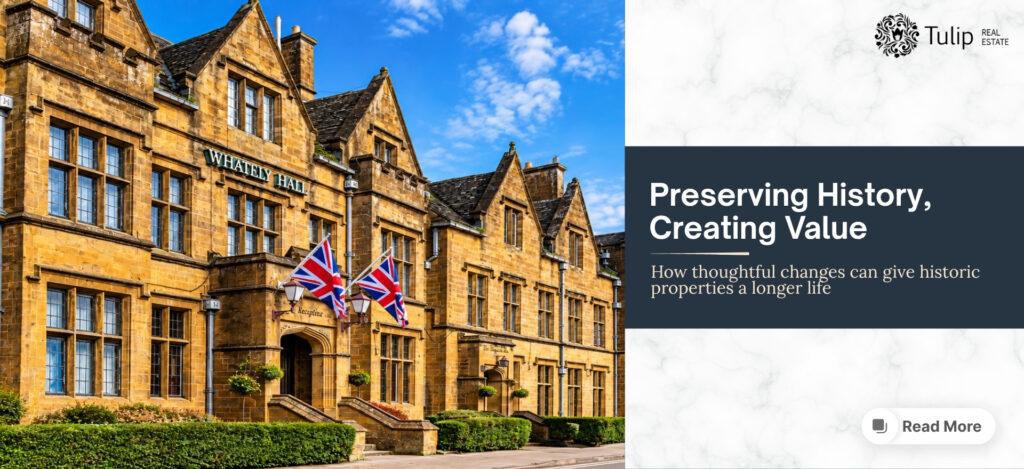
A historic property can be difficult to improve precisely because its strongest feature is the thing that cannot be replaced: its history. At Whately Hall Hotel in Banbury, that challenge has been approached through measured additions rather than a wholesale reinvention. Under Sidd Mahajan’s leadership at Tulip Real Estate, the property has recently gained two new guest rooms, taking its inventory to 71 bedrooms, alongside a heritage walkway designed around its historic 17th-century well.
It is a relatively modest intervention in scale. But it says something useful about how Sidd Mahajan approaches properties with an established identity: improvement does not necessarily mean changing what people already value about a place.
A Property With a Long Memory
Whately Hall dates back to 1677 and sits in Banbury, Oxfordshire, on the banks of the River Cherwell. The property retains features including stone passages, priests’ holes and a historic wooden staircase, alongside its gardens, restaurant and period interiors.
That history creates a different set of considerations from those involved in developing a new residential building or acquiring a contemporary hotel. With an older property, the question is often how to make it more relevant without stripping away the character that makes it distinctive in the first place. That is particularly important in hospitality, where a building’s identity can form part of the guest experience itself.
The Value of a Thoughtful Addition
The recent work at Whately Hall illustrates this balance quite neatly. Adding two bedrooms is a straightforward commercial decision: it increases the property’s accommodation capacity. But the heritage walkway around the 17th-century well serves a different purpose. It turns an existing historical feature into something guests can actively discover and experience.
That distinction matters. A hotel can invest in new furniture, refurbish rooms or add facilities, but those improvements are relatively easy to replicate elsewhere. A historical feature that belongs uniquely to the property cannot be manufactured.
For Siddharth Mahajan, whose professional career began in hospitality in 2001 before expanding into real estate, this combination of commercial improvement and guest experience is particularly relevant. His early career included experience at Oberoi Rajvilas in Jaipur, giving him a hospitality foundation long before Tulip expanded into its current mix of property and hotel assets.
Why Heritage Still Has Commercial Relevance
Heritage is sometimes treated as a limitation in property conversations: something that needs to be preserved while modern requirements are fitted around it. In hospitality, it can instead become part of the proposition.
A historic hotel has something that a newly constructed building has to work considerably harder to create: a sense of place. The architecture, stories and physical details can give guests a reason to remember the property rather than simply remember the room they stayed in.
That does not mean every historical feature automatically adds commercial value. It needs to be accessible, understood and incorporated thoughtfully into the guest experience.
The new heritage walkway at Whately Hall is an example of that principle in practice. The property’s history becomes something guests can engage with rather than something that exists quietly in the background.
The Broader Tulip Perspective
Whately Hall also sits within a wider hospitality portfolio that includes properties such as Warbrook House Heritage Hotel, Holiday Inn Redditch and, more recently, Hilton London Syon Park and DoubleTree by Hilton Swindon. That range is significant because these properties operate in very different settings.
A 17th-century hotel in Banbury requires a different proposition from a contemporary Hilton property or a Grade I listed estate. The common thread is therefore unlikely to be a particular architectural style. It is the ability to understand what makes an asset distinctive and build around that strength. This is where Sidd Mahajan UK becomes an interesting case study in property entrepreneurship. His portfolio has developed across residential real estate, hospitality and different forms of property investment, but individual assets are not necessarily treated as interchangeable pieces.
Whately Hall’s recent improvements suggest a more specific reading of the asset: preserve the character, improve the offering and give its history greater relevance to the people staying there.
Growth Does Not Always Need to Look Dramatic
There is a tendency in real estate to associate progress with scale, a new acquisition, a major development or a headline transaction. Whately Hall presents a quieter version of growth. Two additional rooms may not generate the same attention as a large London acquisition. A heritage walkway will not change a skyline. Yet both contribute to the usefulness and identity of an existing property. That is an important part of Sidd Mahajan’s work at Tulip Real Estate. Alongside major acquisitions and portfolio expansion, there is also the less visible task of making individual assets work better over time.
For Siddharth Mahajan London, Whately Hall offers a particularly clear example of that principle. The property does not need to become something completely different to remain commercially relevant. It needs to keep evolving while retaining the qualities that made it worth preserving.
And sometimes, the smartest property decisions are the ones that know exactly what not to change.
Explore Sidd Mahajan’s work across Tulip Real Estate’s growing UK property and hospitality portfolio.